Integrations
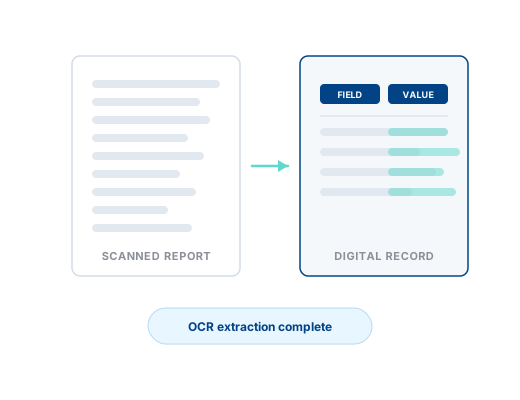
Connect with hospital systems, labs, and external platforms to ensure smooth data exchange and workflow continuity.
Rare disease care involves complex datasets, fragmented workflows, and limited interoperability. IndiGeneUs.AI addresses this by creating a structured, unified system for clinical data and decision support.
The Platform
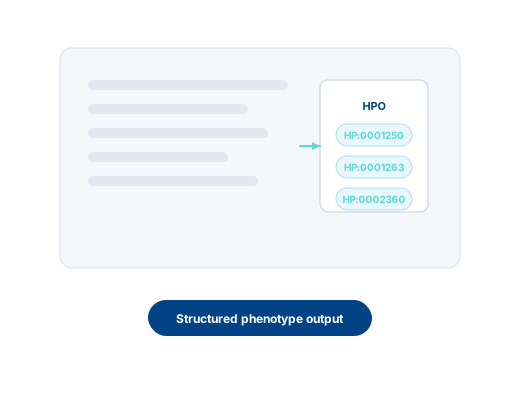
Designed to reduce manual effort across key clinical tasks, enabling faster and more structured workflows.
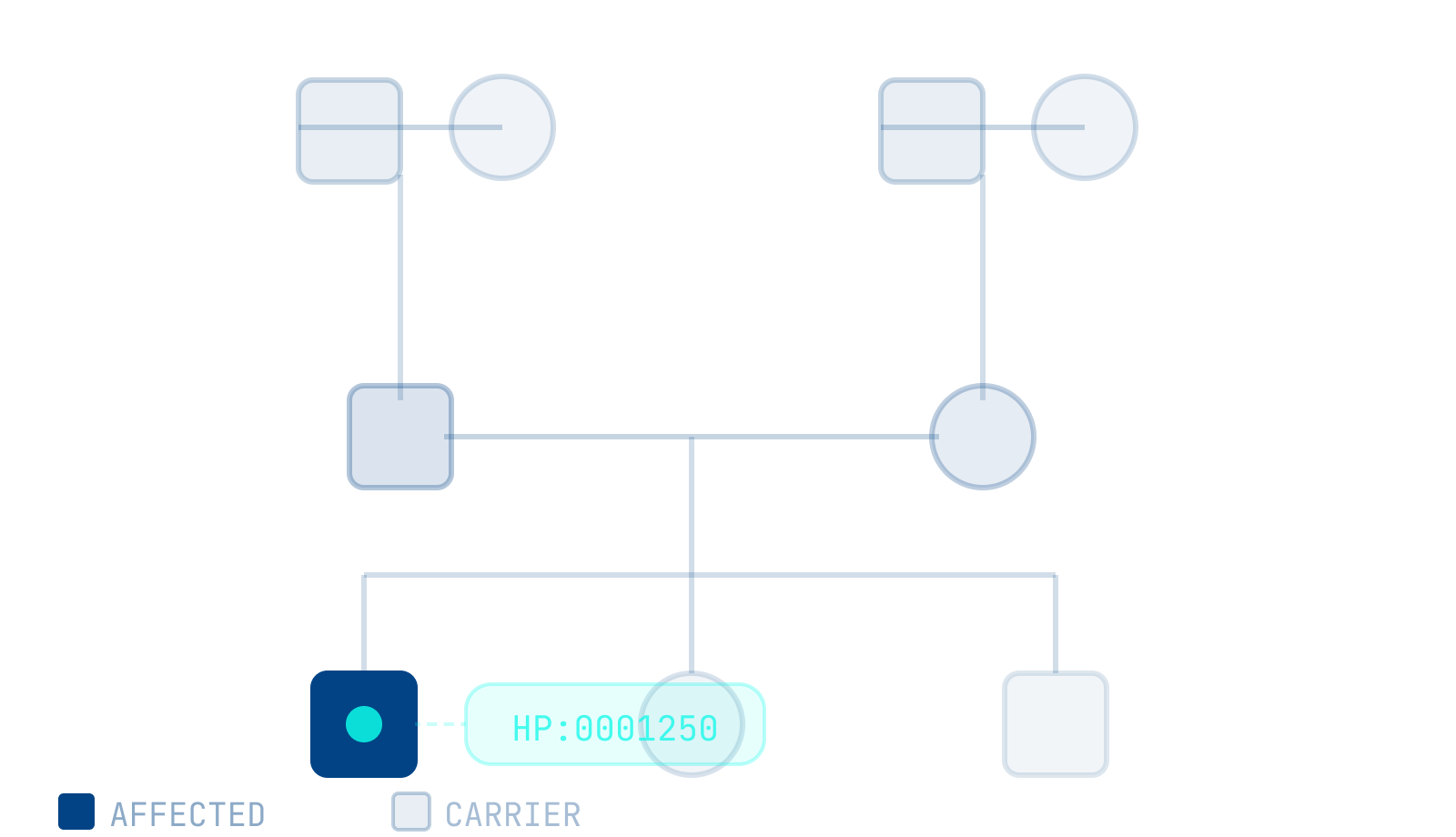
Map inheritance patterns without manual diagramming
Create detailed family trees with an intuitive interface designed for clinical use. Easily map relationships, inheritance patterns, and patient history across generations.

Clinical Intelligence
Not another feature list — a fundamentally different approach to how AI supports rare disease diagnosis.
Differential diagnosis ranked by probability, updated in real time as new clinical data is entered.
Dravet Syndrome
G40.82
GEFS+
G40.30
Lennox-Gastaut
G40.812
Angelman Syndrome
Q93.51
Every recommendation is traceable to specific evidence paths — phenotypic, genomic, and literature-based.
Side-by-side comparison of phenotypically similar conditions to support clinical disambiguation.
Disease A
Dravet Syndrome
Shared
Disease B
Lennox-Gastaut
Longitudinal Care
Enable continuous care through longitudinal tracking and data-driven insights.
Maintain structured patient records across multiple visits, enabling continuity in care and better outcome tracking.
Visualize patient data, identify trends, and analyze cohorts to support clinical and research use cases.
Infrastructure
Designed to integrate seamlessly into existing clinical and institutional environments.
Connect with hospital systems, labs, and external platforms to ensure smooth data exchange and workflow continuity.
Cloud-Based
Managed infrastructure, auto-scaling, zero operational overhead.
On-Premise
Full data sovereignty, custom infrastructure, air-gapped options.
Hybrid
Mix of cloud and on-premise based on data sensitivity policies.
Support both cloud-based and on-premise deployments based on institutional requirements and data policies.
Trust & Safety
Ensure data protection, privacy, and compliance with healthcare standards at every layer.
End-to-end encryption and secure infrastructure for sensitive patient data. SOC 2 Type II certified with zero-trust architecture.
Learn moreGranular access permissions to ensure appropriate data usage across roles — clinicians, admins, researchers, and institutional leads.
Learn moreMaintain complete audit trails and adhere to global healthcare data regulations including HIPAA, DPDP, and NHS standards.
Learn moreTake the stress out of UI design with ready-to-use content.
Book a Demo